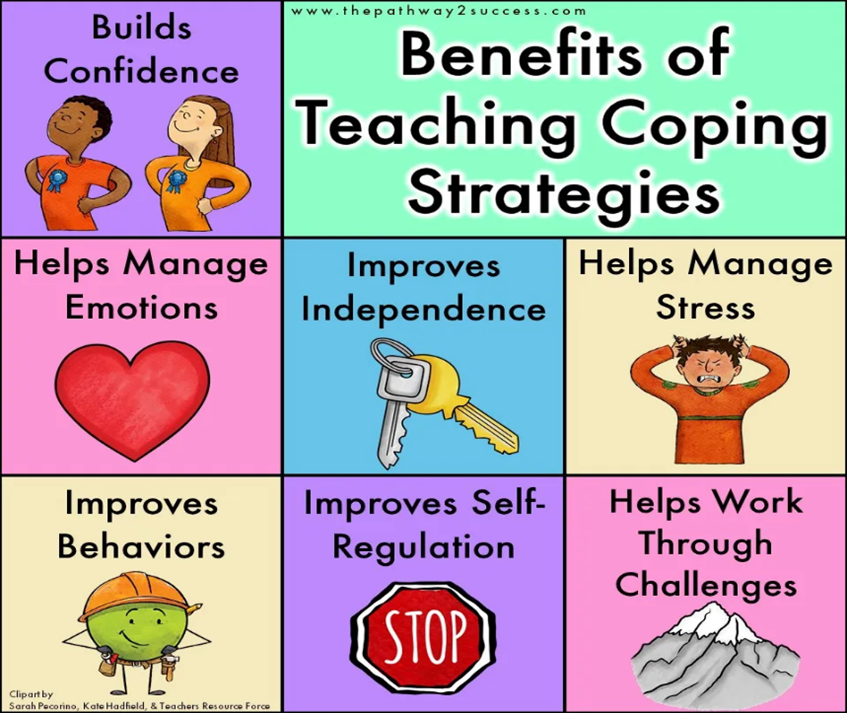
Coping mechanisms refers to the strategies we use to help us manage stressful or uncomfortable situations, which in turn, enables people to process and perform as effectively as possible for themselves. There are a variety of coping strategies, however it is important to understand, what works for someone else might not work for you, so when introducing new strategies, explore a variety of options and see what works best, and always remember to give things time. Some mechanisms take longer to see any outcomes than others, therefore give something time to take into effect and consistency to before ruling it out, 12 weeks is usually a safe bet. To learn more about coping mechanisms, please visit: Coping Mechanisms: Types, Uses, Interpretations.
Types of Coping Mechanisms
There are essentially 5 types of coping mechanisms, however we will only focus on the 2 main types of coping mechanisms: problem/solution focused, and emotion focused.
- Problem / Solution focused – this relates to stress that you have some level of control over and applies a more practical approach to managing your situation.
- Emotion focused – this relates to stress that you can’t manage and requires more of an emotional response, which applies a more mood management approach.
| Problem focused | Emotion focused |
| Tips & Tricks | Tips & Tricks |
| Time management Journaling Planning & to-do list Using conflict resolution Self-love meditation / self-compassion | Setting boundaries See stressors as challenge not threatJournaling your emotions Self-love meditation / self-compassion Vision board (future aspirations) |
| For more information on types of coping mechanism please visit: Coping Skills for Stress and Uncomfortable Emotions | |
What are Coping Skills?
Coping skills, are essential the skillsets / behavioural traits to adapt and/or develop, in order to appropriately implement healthy coping mechanisms.
There are 5 types of coping skills, these are: –
- Emotional regulation – learning to identify and manage your emotions
- Cognitive reframing – changing the way we see the scenario, which in turn changes the way you feel about it
- Problem solving – taking steps to resolve the problem
- Relaxation – calming your body and mind
- Self-Care – taking care of yourself as a whole (physically & emotionally), such as dieting, exercise, sleep…
For more information on coping skills, please visit: What are the 5 Types of Coping Skills? – Mental Health Match.
Adaptive vs Maladaptive Coping Mechanisms
It is important to remember, that although we utilise coping mechanisms to help us feel better or get symptom relief, there are healthy and unhealthy coping mechanisms: these are adaptive (healthy) and Maladaptive (unhealthy).
| Adaptive (empowering) | Mal-Adaptive (stunting) |
| Empowering development | Stunts emotional development |
| – Deep breathing – Meditation – Exercise – Journaling – Talking to friends – Positive thoughts – Taking baths – Reading books – Aromatherapy Massage | – Drinking excessively – Excessive misuse of substances – Anger outbursts – Denial or avoidance – Self-harm – Binge eating / poor diet – Negative thoughts – Isolating yourself – Obsessing / Controlling – Promiscuity |
Introducing Coping Mechanisms
When exploring coping mechanisms, the first thing you need to do is explore your existing coping mechanisms, what type are they and are they adaptive or maladaptive? Once you have identified this, it makes it easier to identify newer and ideally adaptive coping mechanisms. If you notice that the majority of your coping mechanisms are maladaptive, do not panic, now you know and you can slowly start to replace these with healthier coping strategies. For more advice on proposed coping mechanisms, and various different examples of coping strategies you can introduce into your wellbeing, please visit: 71 Coping Skills: A List for Adults to Deal with Anxiety & Stress – Happier Human.
Things to consider when introducing coping mechanisms are: –
- Try a variety of different things and see what works
- Allow time for things to work
- Generally, any emotions that cause you to feel excited and/or agitated, require a coping mechanism that is calming
- Generally, any emotions that cause you to feel low and/or hopeless, require a coping mechanism that is uplifting & cheerful
- Reintroduce activities you previously loved back into your routine
A key thing to take into consideration when it comes to coping strategies is to re-try stuff you had previously tried, which failed. The rationale behind this is, previously you may not have been ready for change, and therefore the commitment and motivation for change impacted its potential effectiveness. I also always recommend having back-up coping mechanisms, as when times get hard, you need to double down, and most importantly, you can get bored doing the same repetitive behaviour, there’s routine and then there’s overkill, and this can put you off or make you feel drained, when you are first introducing change.
Conclusion
When utilising coping mechanisms, it is important to have a variety of different coping mechanisms, and to remember which is the best to use, for your predicament: remember, different emotions require different coping mechanisms. For example, if you are feeling anxious or angry, you require a strategy that will help you calm down and clear your mind, speaking to someone when you are angry, is actually a bad idea. Whereas where you are feeling low mood or depressed, you need to uplift yourself, and speaking to someone helps you feel less alone and gives you the connection you require, due to low mood often causing you to feel disconnected and alone. Therefore, identifying the correct emotion and implementing the relevant coping mechanism is vital, which is why it is important to experiment with a few different ones. As previously mentioned, SMART planning is a great way to manage yourself and goal planning: making it a great tool to aid in making lifestyle changes and reducing stress in the process! (please refer to SMART planning guide).
Takeaway – think of coping mechanisms as a warning sign, when you start to notice that you are regularly having to implement coping mechanisms, then it’s time to take a step back and re-evaluate your mental health and emotional wellbeing, as this is likely a sign of a decline to your wellbeing.
Also check out: Coping Strategies – The Pathway 2 Success for supporting with coping strategies for children and youths!
Disclaimer – Please note, all advice given is based on various healthcare models that have been proven to support patients with sustainability and backed by Public Health England (PHE). Nonetheless, you should run any changes to your routine by your GP as they are your primary carer, it is also important that any other healthcare professionals involved in your care is involved in your goal planning. Don’t forget they hold your medical records and would be familiar with you; this will help everyone to be on the same page and will also enable you to plan more realistically and not overestimate your capacity!
References



27 April 2025, 9:25 pm
Very good https://rb.gy/4gq2o4
29 April 2025, 1:29 am
Awesome https://is.gd/N1ikS2
30 April 2025, 11:43 am
Awesome https://is.gd/N1ikS2
30 April 2025, 2:00 pm
Awesome https://is.gd/N1ikS2
30 April 2025, 2:01 pm
Very good https://is.gd/N1ikS2
30 April 2025, 9:31 pm
Good https://is.gd/N1ikS2
30 April 2025, 10:18 pm
Very good https://is.gd/N1ikS2
24 May 2025, 7:45 am
Top https://shorturl.fm/YvSxU
28 May 2025, 5:21 am
https://shorturl.fm/XIZGD
29 May 2025, 3:10 pm
https://shorturl.fm/m8ueY
30 May 2025, 1:18 pm
https://shorturl.fm/68Y8V
31 December 2025, 9:52 am
Thanks for sharing. I read many of your blog posts, cool, your blog is very good.
15 January 2026, 8:45 am
Can you be more specific about the content of your article? After reading it, I still have some doubts. Hope you can help me.
10 March 2026, 8:34 am
Can you be more specific about the content of your article? After reading it, I still have some doubts. Hope you can help me. https://accounts.binance.com/sk/register-person?ref=WKAGBF7Y
30 April 2026, 4:48 pm
Your article helped me a lot, is there any more related content? Thanks!